Safe co-sleeping
Co-sleeping – sharing a sleeping space with your child – is common in many cultures worldwide and has historically been the norm. In modern Western culture it has become a debated topic where official recommendations often advise against bed-sharing. At the same time, research shows that the risks are primarily associated with specific circumstances, and that co-sleeping can be made safer by following certain guidelines.¹
Different forms of co-sleeping
Co-sleeping can mean sharing a bed (bed-sharing) or sharing a room without sharing a bed (room-sharing). Research and guidelines make an important distinction between these.²
The AAP (American Academy of Pediatrics) recommends room-sharing without bed-sharing for the child's first six months, preferably the first year.² In the UK, the NHS and Lullaby Trust recommend room-sharing for at least six months, but do not advise against bed-sharing altogether – instead providing clear guidelines for risk minimisation.¹³ The Swedish National Board of Health recommends a separate sleeping place and back sleeping, but primarily emphasises avoiding known risk factors such as smoking, alcohol and soft sleep surfaces.¹⁴
Room-sharing has been shown in research to reduce the risk of sleep-related infant death by up to 50% compared with the child sleeping in a separate room.²
Cultural differences
Bed-sharing is common in large parts of the world, particularly in Asia, Africa and Latin America.¹ ¹² In Japan, where bed-sharing is common, the incidence of sleep-related infant death is among the lowest in the world, but this is likely explained by other factors such as low smoking prevalence and firm sleep surfaces.³ The risks of co-sleeping cannot be viewed in isolation but depend on the sleep environment as a whole.
Bed-sharing is also common in Sweden. A large population-based study from Västra Götaland (Wennergren et al., 2021) showed that 43% of infants slept in the parents' bed at three months of age and 33% at six months. The trend is also increasing – in 2003–2004 the corresponding figure at six months was 20%. Baby nests were popular among those who shared a bed, and bed-sharing was positively associated with breastfeeding.¹¹
Risks of bed-sharing
The greatest risk with bed-sharing is associated with situations where one or both parents smoke, have consumed alcohol, used drugs or sedating medication, or when the child sleeps on a soft or unsuitable surface such as a sofa or armchair. These factors considerably increase the risk of sleep-related infant death and suffocation.⁴ ⁵
A large meta-analysis (Carpenter et al., 2013) found that the risk was particularly elevated when the parent smoked, but that an elevated risk remained even without known risk factors in very young infants (under 3 months). However, the study has been criticised for methodological limitations, including the difficulty of fully controlling for all risk factors in the included studies.⁶
Relative risk by sleeping arrangement
Approximate odds ratios compared with the child sleeping in their own bed in the parents' room (reference = 1).
Falling asleep with an infant on a sofa or armchair is associated with the highest risk in the research, roughly 18 times higher than the reference level.(Moon & Task Force, 2016)
Smoking is the single strongest risk factor for bed-sharing. The risk is elevated regardless of whether the parent smokes in or outside the bedroom.(Carpenter et al., 2013)
Alcohol reduces the parent's arousal sensitivity and increases the risk of unintentionally overlaying the child.(Blair et al., 1999)
Sleeping in a separate room during the child's first 6 months is associated with roughly double the risk compared to room-sharing, according to AAP guidelines.(Moon & Task Force, 2016)
Blair et al. (2014) found no statistically significant increase in risk for bed-sharing without known risk factors (OR 1.1; 95% CI 0.6–2.0).(Blair et al., 2014)
Reference level. Recommended practice: the child sleeps on their back in their own bed in the parents' room.(AAP, 2016)
Click a bar to read more. Values are approximate and based on observational studies with varying methodology.
somnfakta.comBenefits and protective factors
Blair et al. (2014) conducted an in-depth analysis of the same question, partly in response to Carpenter's results. By more carefully isolating cases where no known risk factors were present, they found that the risk of bed-sharing was very low and not statistically significant compared with the child sleeping in their own bed in the same room. The researchers emphasised that it is the combination of risk factors that constitutes the real danger, not co-sleeping itself.⁷
These two studies illustrate an ongoing scientific discussion: the question is not whether risk factors like smoking and alcohol are dangerous – there is broad consensus on that – but whether bed-sharing in itself poses a risk when such factors are absent. In practice, this discussion has led to risk-minimisation principles, such as the Safe Sleep Seven below, becoming an established part of guidance.
Bed-sharing can facilitate breastfeeding, increase breastfeeding duration and strengthen closeness between parent and child. Breastfeeding mothers who share a bed tend to breastfeed longer and more frequently.⁸ Breastfeeding in combination with co-sleeping has been associated with more nighttime sleep for the mother in several studies.⁸
Safe Sleep Seven
The "Safe Sleep Seven" is a set of guidelines developed by La Leche League International, based on research on risk minimisation during co-sleeping. The seven criteria describe the conditions under which co-sleeping is considered lowest risk.⁹
The parent sharing the bed should be: 1. A non-smoker 2. Sober – no alcohol, drugs or sedating medication 3. Breastfeeding
The child should be: 4. Healthy and full-term 5. Placed on their back
The sleep environment should have: 6. No loose blankets, pillows or other objects near the child 7. A firm mattress without gaps or spaces where the child can become trapped⁹
If breastfeeding is not applicable
The Safe Sleep Seven were developed based on research on breastfeeding mothers. Breastfeeding is included as a criterion partly because breastfeeding mothers show higher arousal sensitivity during sleep and naturally assume the protective C-position, and partly because breastfeeding in itself is a protective factor against sleep-related infant death.⁸ The evidence for bed-sharing with formula feeding is more limited since the protective effect of breastfeeding is absent, and research has not been able to establish the same low risk level. If all other criteria are met, the risk is substantially lower than with known risk factors such as smoking, alcohol or soft sleep surfaces, but most guidelines recommend room-sharing with a separate sleeping place (e.g. a bedside crib) for formula feeding.² UNICEF Baby Friendly Initiative gives similar recommendations and emphasises the importance of supporting breastfeeding families with individually tailored guidance.¹⁵
Planned versus unplanned co-sleeping
Ball et al. (2016) showed that planned co-sleeping in bed, where parents have consciously adapted the sleep environment, is safer than unplanned co-sleeping that occurs out of tiredness, for example on a sofa. This argues for giving parents information about risk minimisation rather than simply advising against it.¹⁰
It is important to emphasise that a sofa or armchair is never a safe place to fall asleep with an infant. The risk of suffocation is many times higher compared with a bed, and this is consistent across all research.⁴
Baby nest
Baby nests (also called sleep pods or DockATot) are popular in Sweden, particularly among families who share a bed. In Wennergren et al. (2021), baby nests were common among co-sleeping families.¹¹
Despite their popularity, several organisations (AAP, Lullaby Trust and Red Nose) advise against using baby nests for sleep. The products do not meet current safety standards for infant sleep, and there is a theoretical risk of suffocation if the child turns their face against the soft edge.² ¹³ ¹⁶
It should be noted, however, that research specifically on baby nests is very limited. The advice against them is based primarily on the precautionary principle and on general guidelines that infants should sleep on a firm, flat surface without soft edges, rather than on studies that have directly investigated the risk of baby nests.
Practical advice for safe co-sleeping
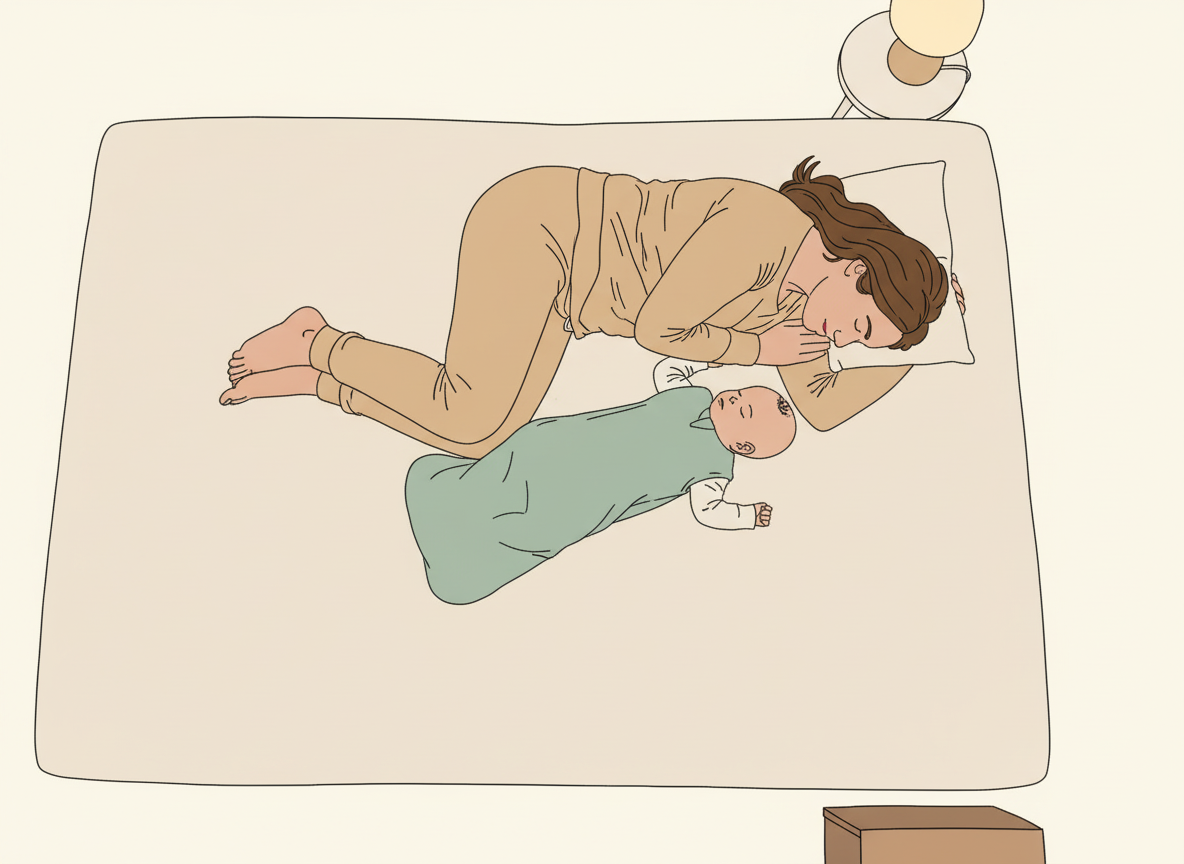
- •The mattress should be firm and flat. Pillows, heavy blankets and other loose objects should be removed from the child's vicinity.
- •The child is placed on their back at breast height – that is, level with the parent's breast – where the parent naturally assumes a protective C-position with knees drawn up and arm above the child's head.
- •Co-sleeping should not take place on a sofa, in an armchair or on a waterbed.
- •If a parent smokes, has consumed alcohol or has taken medication that causes drowsiness, bed-sharing is advised against.
- •For premature infants or low birth weight babies, contact a paediatrician before considering bed-sharing.⁴
- •When the child starts to move and roll, the bed should be secured against falls. The mattress can be placed directly on the floor or against a wall without gaps.⁹ Placing pillows at the bed edge as fall protection is advised against, as they pose a suffocation risk for infants.⁴
Related
References
- McKenna, J. J. & McDade, T. (2005). Why babies should never sleep alone: a review of the co-sleeping controversy in relation to SIDS, bedsharing and breast feeding. Paediatric Respiratory Reviews, 6(2), 134–152.
- Moon, R. Y. & Task Force on Sudden Infant Death Syndrome (2016). SIDS and other sleep-related infant deaths: evidence base for 2016 updated recommendations. Pediatrics, 138(5), e20162940.
- Watanabe, N. et al. (2009). Epidemiology of sudden infant death syndrome in Japan. Acta Paediatrica, 98(9), 1409–1414.
- Task Force on Sudden Infant Death Syndrome (2016). SIDS and other sleep-related infant deaths: updated 2016 recommendations for a safe infant sleeping environment. Pediatrics, 138(5), e20162938.
- Vennemann, M. M. et al. (2012). Bed sharing and the risk of sudden infant death syndrome: can we resolve the debate? Journal of Pediatrics, 160(1), 44–48.
- Carpenter, R. et al. (2013). Bed sharing when parents do not smoke: is there a risk of SIDS? BMJ Open, 3(5), e002299.
- Blair, P. S. et al. (2014). Bed-sharing in the absence of hazardous circumstances: is there a risk of sudden infant death syndrome? An analysis from two case-control studies conducted in the UK. PLoS ONE, 9(9), e107799.
- Ball, H. L. (2003). Breastfeeding, bed-sharing, and infant sleep. Birth, 30(3), 181–188.
- Wiessinger, D., West, D. & Pitman, T. (2014). Sweet Sleep: Nighttime and Naptime Strategies for the Breastfeeding Family. La Leche League International / Ballantine Books.
- Ball, H. L., Howel, D., Bryant, A., Best, E., Russell, C. & Ward-Platt, M. (2016). Bed-sharing by breastfeeding mothers: who bed-shares and what is the relationship with breastfeeding duration? Acta Paediatrica, 105(6), 628–634.
- Wennergren, G., Strömberg Celind, F., Goksör, E. & Alm, B. (2021). Swedish survey of infant sleep practices showed increased bed-sharing and positive associations with breastfeeding. Acta Paediatrica, 110(6), 1835–1841.
- Nelson, E. A. et al. (2001). International Child Care Practices Study: infant sleeping environment. Early Human Development, 62(1), 43–55.
- Lullaby Trust (2024). Co-sleeping with your baby. https://www.lullabytrust.org.uk/safer-sleep-advice/co-sleeping/
- Socialstyrelsen (2014). Minska risken för plötslig spädbarnsdöd: en vägledning för hälso- och sjukvårdspersonal. Stockholm: Socialstyrelsen.
- UNICEF UK Baby Friendly Initiative. Caring for your baby at night. unicef.org.uk. Hämtad 2025.
- Red Nose (formerly SIDS and Kids). Safe sleeping. rednose.org.au. Hämtad 2025.